
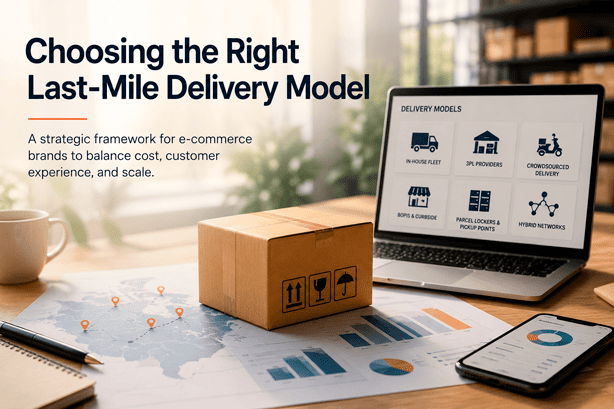
There is no universal last-mile delivery strategy. There is only the right strategy for your order volume, your customer base, your geographic footprint, and your margin structure.
Most e-commerce brands choose a delivery model based on what’s available or what’s familiar — not based on what the math actually supports. That default thinking is expensive in a market where last-mile costs represent more than half of total supply chain spend and customer expectations are reset every time Amazon makes another operational move.
This is a framework for making the decision correctly.
Why the Delivery Model Decision Is Harder Than It Looks
The U.S. last-mile delivery market sits at the intersection of rising customer expectations, increasing operational costs, and accelerating technology adoption. Getting the model right isn’t a one-time decision. It’s an ongoing calibration.
The brands that do this well ask a specific set of questions before committing to any delivery approach:
- Does this model work at my current order density, or only at a volume I haven’t reached yet?
- Can this model serve my geographic mix — urban, suburban, and rural — without creating coverage gaps that drive customer complaints?
- What does this model cost per delivery when all fees, labor, and secondary costs are included?
- Does this model give me the reliability metrics my customer base actually expects?
- Can I scale this model without the unit economics deteriorating?
The answer to those questions points toward one of six primary delivery models operating in the U.S. market today.
The Six Last-Mile Delivery Models — and When Each One Wins
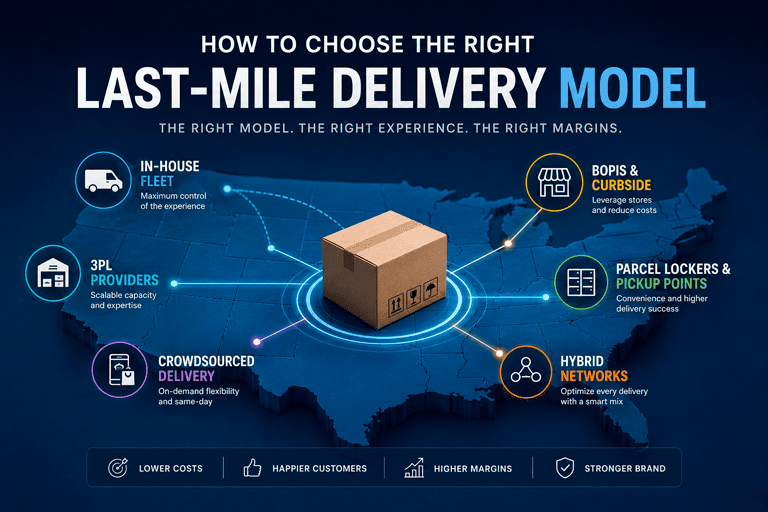
1. In-House Fleet
Operating your own delivery vehicles and drivers gives you maximum control over the customer experience. You set the delivery window, you manage the driver interaction, you control what happens when something goes wrong.
That control comes at a price. Building and maintaining a fleet requires capital investment in vehicles, technology, insurance, and driver management that most brands cannot justify below certain order volumes. In-house fleets make the most sense for high-value products, bulky or fragile merchandise requiring careful handling, white-glove delivery services, and brands where the last delivery interaction is itself a brand moment worth controlling.
The trap is building an in-house fleet to solve a coverage problem that a carrier partnership would solve more cheaply.
2. 3PL Providers
Third-party logistics providers offer outsourced fulfillment and delivery infrastructure that scales with your volume. You get broad geographic coverage, established carrier relationships, and operational expertise without the capital requirements of running your own network.
The tradeoff is reduced control. When a 3PL manages your delivery, you are dependent on their systems, their carrier relationships, and their exception handling processes. For brands where the delivery experience is a core brand differentiator, that dependency carries real risk.
3PL partnerships work best when your order volume is large enough to negotiate meaningful service-level agreements but not large enough to justify proprietary infrastructure.
3. Crowdsourced Delivery
Platforms like DoorDash Drive, Uber Direct, and Instacart give brands access to flexible, on-demand delivery capacity without fixed fleet costs. You pay per delivery, capacity scales up and down with demand, and you can activate same-day delivery capability without building the underlying infrastructure.
The economics work well for same-day delivery in urban markets, for businesses with highly variable demand patterns, and for categories where delivery speed is a genuine purchase driver.
The limitations are real. Crowdsourced networks have inconsistent coverage outside dense urban markets, limited ability to handle specialized delivery requirements, and variable service quality that can be harder to manage than a contracted carrier relationship.
4. BOPIS and Curbside Pickup
Buy Online, Pick Up In Store and curbside pickup models shift the last-mile cost equation fundamentally. When the customer completes the final mile themselves, the brand eliminates carrier fees, failed delivery risk, and the secondary costs associated with residential delivery exceptions.
BOPIS adoption has grown significantly in the post-pandemic U.S. market. For brands with physical retail locations, it represents one of the most cost-effective fulfillment options available — provided the in-store pickup experience meets the same quality standard as home delivery.
The operational requirement is inventory accuracy. BOPIS fails when customers arrive for items that aren’t actually available.
5. Parcel Lockers and Pickup Points
Consolidated delivery to locker networks and pickup locations reduces the cost and complexity of residential delivery by replacing individual home delivery attempts with single-stop consolidated drops. Failed delivery rates drop significantly. Per-unit delivery costs decline. And customers retain flexibility to collect packages on their own schedule.
The adoption curve in the U.S. is still behind European markets, but locker networks operated by Amazon, UPS, FedEx, and third-party providers are expanding. For brands with customers who frequently experience failed home deliveries — apartment dwellers, customers in buildings with limited access — locker options improve the delivery success rate measurably.
6. Hybrid Multi-Carrier Networks
Most sophisticated U.S. e-commerce operators don’t rely on a single delivery model. They build hybrid networks that route shipments to the optimal carrier or delivery method based on destination, package characteristics, delivery speed requirements, and cost thresholds.
A hybrid approach means using national carriers for broad coverage, regional carriers for density markets where they outperform on cost and speed, crowdsourced networks for same-day urban delivery, and BOPIS or locker options where they improve success rates and reduce cost.
The operational requirement for a hybrid model is technology. Without route optimization software, carrier management systems, and real-time tracking infrastructure, the complexity of managing multiple delivery channels creates more problems than it solves.
How Technology Changes the Decision
The right delivery model in 2026 is inseparable from the technology stack supporting it.
Route optimization is the most direct technology investment available in last-mile logistics. AI-driven routing reduces delivery distance by up to 30% in dense markets, which translates directly to lower fuel costs, higher driver productivity, and better on-time performance.
Warehouse and Order Management Systems that integrate inventory visibility across channels are the foundation of accurate delivery promises. If your OMS doesn’t know where inventory actually is, your delivery windows are guesses. Customers who receive packages later than promised don’t distinguish between a logistics failure and a systems failure. They experience it as a brand failure.
Real-time tracking is no longer a premium feature. It’s a baseline expectation. Customers who can track their package in real time generate fewer support contacts and report higher satisfaction scores, even when delivery takes longer than they hoped. The transparency itself has value.
Electric vehicle fleets are becoming economically competitive in high-density urban delivery routes where stop frequency is high and range requirements are manageable. The operational cost case is strengthening as EV costs decline and fuel costs remain volatile.
Autonomous delivery and drones remain in early commercial deployment but are advancing faster than most analysts projected. For brands in suburban markets with favorable regulatory environments, drone delivery is worth monitoring as a near-term option rather than a distant possibility.
A Decision Framework for Choosing Your Model
The right delivery model for your business follows from three questions answered honestly.
What does your order geography actually look like?
Dense urban markets support crowdsourced delivery economics and justify investment in route optimization. Suburban markets are where national and regional carriers typically perform best. Rural coverage gaps are real and require carrier diversification or acceptance of service limitations.
Map your actual order density before choosing a model. The model that works for your top five metropolitan markets may not work for the 40% of orders shipping to addresses outside those markets.
What does your customer actually value?
Some categories compete on speed. Groceries, same-day replenishment, and time-sensitive purchases need fast delivery infrastructure. Most e-commerce categories compete on reliability and cost. Customers in those categories will accept longer delivery windows in exchange for free shipping and accurate delivery promises.
Design your delivery model around what your specific customer base values — not around what Amazon offers, unless you are actually competing for the same customer in the same moment.
What can your margin structure actually support?
Last-mile delivery is a cost center until it becomes a competitive advantage. Brands with strong margins can invest in premium delivery infrastructure that becomes a brand differentiator. Brands operating on tighter margins need to optimize ruthlessly for cost efficiency before investing in speed.
Run the unit economics on each delivery model at your actual order volume and geographic mix. The model that looks best on a vendor pitch deck may look very different when applied to your specific shipment profile.
The Operational Challenges Nobody Advertises
Every last-mile delivery model has failure modes that vendors underemphasize and operators discover after the contract is signed.
Urban congestion is getting worse in every major U.S. metro. Delivery windows that worked two years ago may be impossible to honor today without investment in routing technology or shift timing adjustments.
Driver availability is a structural challenge, not a temporary one. Brands running in-house fleets and 3PLs with proprietary driver networks are competing for the same labor pool. Retention investment is not optional.
Peak season compression is intensifying. The window between Thanksgiving and Christmas generates delivery volume that overwhelms networks built for average demand. Brands without capacity agreements in place before Q4 pay surge pricing or lose service quality at the worst possible moment.
Return volume scales with delivery volume. A delivery model that works for outbound shipments needs a parallel reverse logistics capability. Brands that treat returns as an afterthought build reverse logistics costs into their P&L without planning for them.
The Bottom Line
The most expensive last-mile delivery decision is defaulting to the same approach your category used five years ago.
U.S. e-commerce customers have more alternatives, higher expectations, and lower switching costs than at any previous point in the market’s history. The brands that are building durable competitive positions are the ones treating last-mile delivery as a strategic investment rather than a necessary cost.
Choose the delivery model that matches your geography, your customer expectations, and your margin structure. Build the technology stack that gives you visibility and control. Measure the KPIs that predict customer experience outcomes, not just the metrics that make the logistics dashboard look good.
Last-mile delivery is where operational discipline becomes customer loyalty.
That’s the framing worth building your logistics strategy around.