
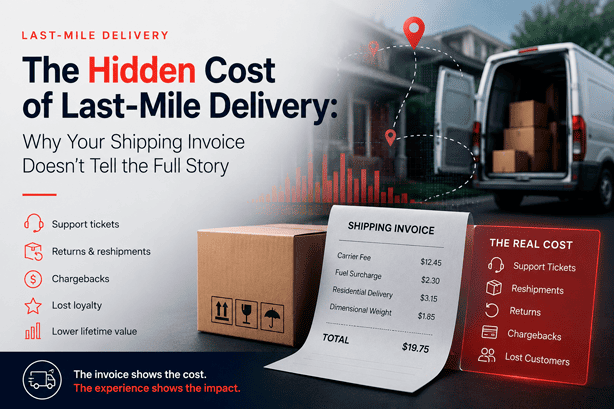
Most e-commerce operators treat last-mile delivery as a line item. They look at cost per shipment, negotiate carrier rates, and move on. That framing misses the real problem.
The invoice never shows the full bill.
When a package arrives late, damaged, or not at all, the financial damage doesn’t show up in your logistics dashboard. It shows up in your support queue, your return rate, your chargeback volume, and eventually in your repeat purchase data. Last-mile delivery is not a logistics function anymore. For most U.S. e-commerce brands, it has become a direct driver of customer loyalty, brand perception, and long-term profitability.
That’s the framing most delivery cost analyses skip. And skipping it is expensive.
The Delivery Experience Gap Is Wider Than Most Brands Realize
U.S. e-commerce now accounts for 16.9% of total retail sales, and that share is still growing. Amazon trained an entire generation of online shoppers to expect fast, free, and frictionless delivery. The operational standard Amazon set is now the emotional baseline every other brand is measured against — regardless of whether you run a $500M fulfillment network or a regional Shopify store.
The gap between customer expectations and actual delivery performance is where brands quietly lose money.
Consider what the data shows:
- 45% of U.S. shoppers abandon a cart when free shipping isn’t available
- 90% of shoppers will extend their expected delivery window by two to three days if it means avoiding a shipping fee
- 80% of shoppers will wait up to a week if shipping is genuinely free
Speed is not the primary variable. Reliability and cost are.
Yet most brands optimize their logistics for velocity while underinvesting in consistency. That mismatch produces a predictable result: on-time rates that look acceptable in aggregate but generate a steady stream of exceptions that quietly drain margin.
What the Invoice Misses

Here is where last-mile economics get genuinely complicated.
The visible costs are easy to track. Carrier fees. Fuel surcharges. Dimensional weight charges. Labels. These are real and they’re significant — last-mile delivery typically represents more than 53% of total shipping costs in a standard e-commerce fulfillment chain.
The invisible costs are where most brands undercount.
Support ticket volume. Every failed delivery attempt, missing package, and delayed shipment generates a customer service interaction. At scale, those interactions are not free. They consume labor, tools, and management attention that could be directed toward growth.
Reshipments and replacements. When a delivery fails completely, most brands absorb the cost of reshipping the item. That means paying fulfillment and carrier costs twice on a single sale — before accounting for the original unit cost.
Return processing. Failed deliveries often trigger returns. Returns have their own cost structure: inbound freight, restocking labor, inspection time, and in many categories, write-downs on merchandise that cannot be resold at full price.
Brand damage. This is the hardest cost to quantify and the most important one to understand. A customer who receives a damaged or missing package doesn’t just file a complaint. They form a lasting impression of your brand. In an environment where switching costs are low and competitors are one Google search away, a single poor delivery experience can permanently eliminate a repeat purchase that would have compounded over years.
Lost loyalty. Acquiring a new customer in U.S. e-commerce costs between $30 and $150 depending on category and channel. Retaining an existing customer is dramatically cheaper. Brands that treat delivery failures as logistics problems rather than customer experience failures are effectively discounting the lifetime value of their customer base without recognizing it on any financial statement.
The most dangerous metric in last-mile delivery is an on-time rate that looks healthy while these secondary costs accumulate unnoticed underneath it.
Reliability Is the New Speed
The conventional wisdom in last-mile logistics was built around a simple idea: faster is better. Get it there in two days. Then one day. Then same day.
That framing is becoming outdated for most e-commerce categories.
What U.S. consumers increasingly want is not simply faster delivery. They want predictable delivery. They want to know exactly when a package will arrive and have that commitment honored. A package that arrives in five days, on the day it was promised, produces a better customer experience than a package that was supposed to arrive in two days and showed up in three.
This shift has operational implications that go beyond carrier selection.
Predictable delivery requires:
- Accurate delivery windows at checkout, not optimistic estimates that erode trust when they slip
- Real-time tracking that gives customers visibility and control, not just a static confirmation email
- Proactive exception handling that contacts customers before they have to contact you
- First-attempt success rates that minimize the secondary costs described above
Brands that invest in delivery reliability — not just delivery speed — consistently outperform on customer satisfaction scores, repeat purchase rates, and net promoter metrics. The operational investment pays for itself through reduced support costs and higher customer lifetime value.
The Four Hidden Cost Drivers Most Brands Underestimate
Understanding where last-mile costs actually originate requires looking beyond the carrier invoice.
Labor. Driver wages, benefits, and retention costs are rising across the U.S. market. In urban markets with strong labor competition, driver shortage is a structural problem, not a temporary one. Brands running in-house fleets feel this directly. Brands using 3PL and carrier networks feel it indirectly through rate increases.
Failed delivery attempts. Industry data suggests that between 6% and 12% of residential delivery attempts fail on the first try. Each failed attempt costs money to reattempt and often generates the secondary costs described above. Improving first-attempt success rates is one of the highest-ROI operational investments available in last-mile logistics.
Fuel and surcharges. Fuel costs are volatile and carrier surcharges often move faster than contract renegotiations can accommodate. Brands without diversified carrier relationships are exposed to rate spikes that compress margin quickly.
Returns. U.S. e-commerce return rates average 20–30% depending on category. Each return represents a delivery that generated cost but failed to generate retained revenue. Managing return logistics efficiently is as important as managing outbound delivery.
Key Performance Indicators That Actually Matter
Most brands track the wrong delivery metrics.
Revenue and order volume are useful business metrics. They are not delivery performance metrics. The KPIs that predict last-mile profitability and customer experience outcomes are more specific:

Brands that track these metrics at the SKU and geography level — not just at the aggregate account level — identify cost problems before they become structural and identify service gaps before they become brand problems.
The Practical Takeaway
Last-mile delivery is where your brand promise meets the physical world. Everything upstream — product quality, marketing, merchandising, checkout experience — is validated or undermined in the final mile.
The brands that treat last-mile as a strategic function rather than a logistics cost center build a measurable competitive advantage. They reduce support costs, improve retention rates, and protect margin in ways that don’t show up on the carrier invoice but absolutely show up on the P&L.
The question isn’t whether you can afford to invest in last-mile delivery optimization.
The question is whether you can afford not to.